Sailgene Technology

All categories
Sailgene Technology

Introduction
Full-length microbial diversity sequencing refers to the use of third-generation sequencing technology to obtain full-length 16S rDNA sequences of bacteria, followed by bioinformatics analysis of the generated data. This approach not only enhances the resolution of species identification but also improves the accuracy of determining microbial composition in samples, thereby truly reconstructing the authentic microbial community structure within the samples.
Applications

Medical Field: Studies on the relationship between common diseases and the human microbiota

Animal Science Field: Research on intestinal/rumen microbiota (e.g., methanogenic microbial communities) in relation to animal health and nutrient digestion, etc.

Agricultural Field: Studies on plant-rhizosphere microbial interactions, and the effects of agricultural tillage/fertilization practices on soil microbial communities, etc.

Environmental Field: Research on haze remediation, sewage treatment, oil degradation, acid mine drainage treatment, and marine environmental studies, etc.

Special Extreme Environments: Studies on microbial taxa under extreme environmental conditions
Product Advantages

Superior Alignment Rate: Higher sequence alignment rate for annotation across all taxonomic levels

Higher Resolution: Full-length 16S sequences enable species-level taxonomic analysis

More Accurate Microbial Community Reconstruction
Workflow

Bioinformatics Analysis
Fast And Comprehensive Bioinformatics Analysis
Library Preparation Flowchart
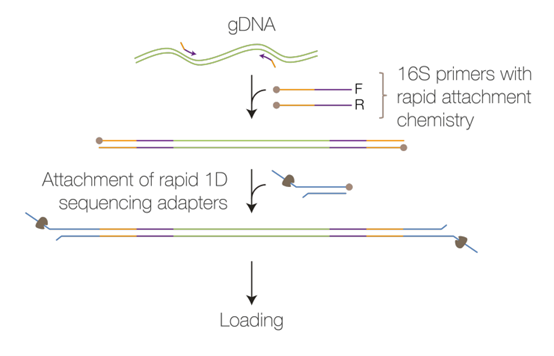
Nanopore Sequencing Experimental Workflow (Taking 16S rRNA as an Example)
Analysis Flowchart
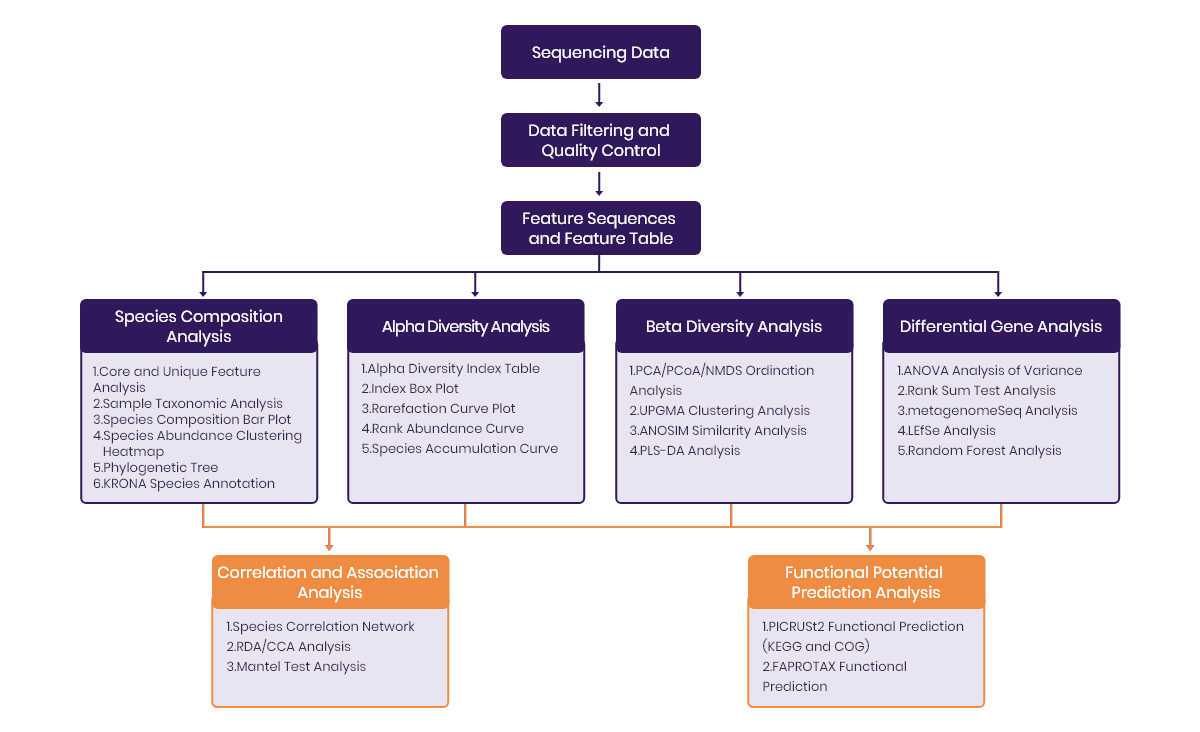
Data Delivery Format
FASTQ
Comparison with Other Technologies
|
Comparison Dimension |
Next-Generation Amplicon Sequencing (Illumina Platform) |
Third-Generation Amplicon Sequencing (taking ONT as an example) |
|
Read Length Characteristics |
Short read length (for 16S rRNA, typically targets single/combined hypervariable regions such as V3-V4, with a length of 250-400 bp) |
Long read length (full-length sequencing of 16S/18S/ITS, with a length of 1.5-5 kb, covering all hypervariable regions and conserved regions) |
|
Species Resolution |
Predominantly genus-level identification; species-level identification achievable for some taxa (dependent on hypervariable region specificity) |
Stably achieves species-level identification; supports strain-level differentiation in specific scenarios (e.g., precise tracing of drug-resistant strains) |
|
Annotation Accuracy |
Fragmented hypervariable region information leads to ambiguity in intraspecific taxonomic annotation; alignment rate approximately 85%-90% |
Full-length sequences contain complete phylogenetic information; alignment rate ≥95%, with species-level annotation accuracy improved by over 30% |
|
Chimerism and Error Rate |
High PCR amplification cycles result in a chimerism rate of approximately 5%-10%; sequencing error rate ~0.1% (random errors) |
Single-molecule sequencing reduces PCR bias; chimerism rate ≤2%; errors can be corrected via algorithms (final accuracy ≥99.9%) |
|
Technical Flexibility |
Relies on large-scale sequencers; only supports batch sample testing, with limited application scenarios |
ONT devices are portable (e.g., MinION); supports single-sample/small-batch sequencing and on-site real-time analysis |
|
Application Scenarios |
Large-scale microbial diversity screening, preliminary analysis of community structure |
High-resolution species identification, differentiation of closely related species, detection of low-abundance microorganisms, research on microorganisms in extreme environments, precise tracing of clinical pathogens |
Article Case
1. Disease severity of root rot affects rhizosphere microbial community structure and network stability of Taraxacum kok-saghyz Rodin

Publication Date: December 2025
Journal & Impact Factor: Rhizosphere; 3.5
DOI: https://doi.org/10.1016/j.rhisph.2025.101230
Citation: Qinqin Nie, Guoen Ao, Shengchan Wang, et al. Disease severity of root rot affects rhizosphere microbial community structure and network stability of Taraxacum kok-saghyz Rodin. Rhizosphere, Volume 36, 2025, 101230, ISSN 2452-2198.
2. Toxic effects of combined exposure to cadmium and diclofenac on freshwater crayfish (Procambarus clarkii): Insights from antioxidant enzyme activity, histopathology, and gut microbiome
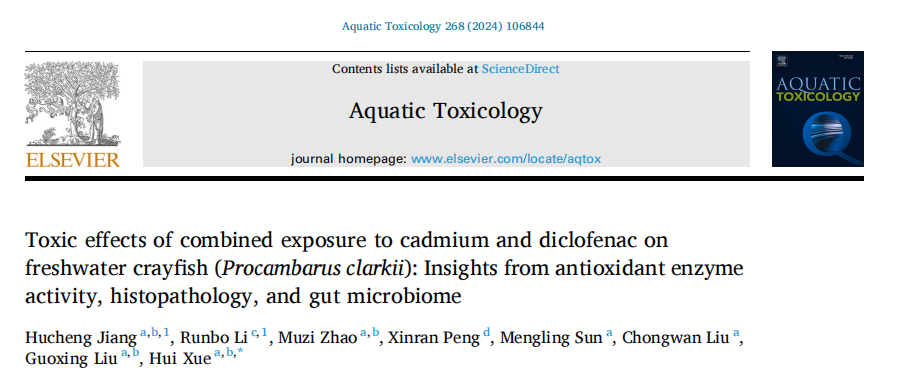
Publication Date: March 2024
Journal & Impact Factor: Aquatic Toxicology (Aquat Toxicol); 4.1
DOI: 10.1016/j.aquatox.2024.106844
Citation: Jiang H, Li R, Zhao M, Peng X, Sun M, Liu C, Liu G, Xue H. Toxic effects of combined exposure to cadmium and diclofenac on freshwater crayfish (Procambarus clarkii): Insights from antioxidant enzyme activity, histopathology, and gut microbiome. Aquatic Toxicology (Aquat Toxicol), 2024 Mar; 268: 106844. https://doi.org/10.1016/j.aquatox.2024.106844. Epub 2024 Jan 26. PMID: 38295602.
Sample Submission Requirements
Full-Length Amplicon Specifications:
DNA Sample Requirements
|
Library Type |
Sample Type |
Amount |
Volume |
Concentration |
Purity (NanoDropTM/Agarose Gel) |
|
Full-Length Amplicon |
Total DNA |
≥100 ng |
≥20 μL |
≥5 ng/μL |
OD260/280=1.8-2.0 no degradation no contamination |
Other types of samples can be consulted with the application scientist
Contact Us
If you are interested in our long-read sequencing services or potential collaboration, please contact us. Our team is ready to support your research with tailored solutions. We also welcome feedback from users to help us improve our services.

Contact Us
Add: 82 Wendell Avenue, Pittsfield, Massachusetts, USA
在线客服添加返回顶部
右侧在线客服样式 1,2,3 1
图片alt标题设置: SAILGENE TECHNOLOGY INC.
表单验证提示文本: Content cannot be empty!
循环体没有内容时: Sorry,no matching items were found.
CSS / JS 文件放置地


