Sailgene Technology

All categories
Sailgene Technology

Introduction
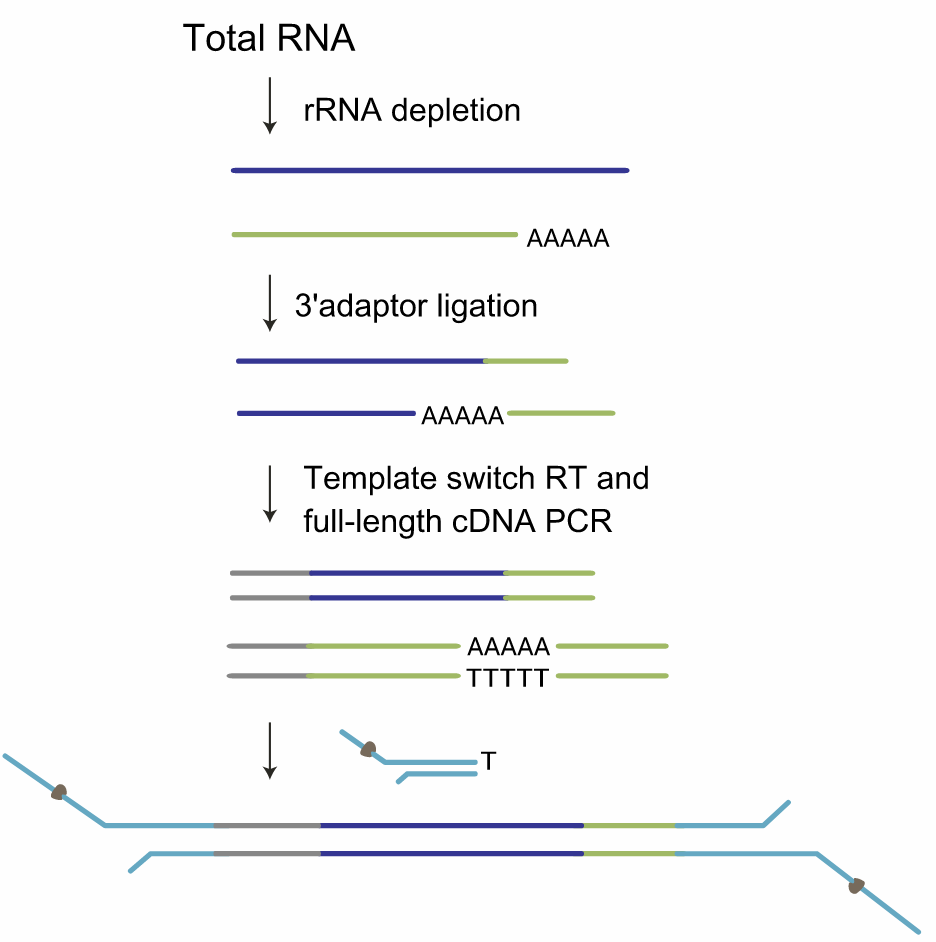
Full-length IncRNA sequencing refers to the direct acquisition of the entire sequence from the 5' end to the 3' end of reverse-transcribed cDNA without fragmenting RNA following rRNA depletion. It does not rely on Poly(A) tail enrichment, thereby enabling the identification and quantification of both Poly(A)-tailed and non-tailed IncRNA transcripts. Furthermore, it systematically performs comprehensive analysis of alternative splicing events in IncRNA molecules.
Applications

Developmental Biology Research

Oncology Research

Immunoinfection Research

Environmental Toxicology Research
Highlights

Obtain full-length lncRNA sequences directly without splicing

Quantify lncRNA transcripts

Identify alternative splicing events in lncRNAs

Capture other RNA types such as mRNA, tRNA, and small RNA
Library Construction Workflow
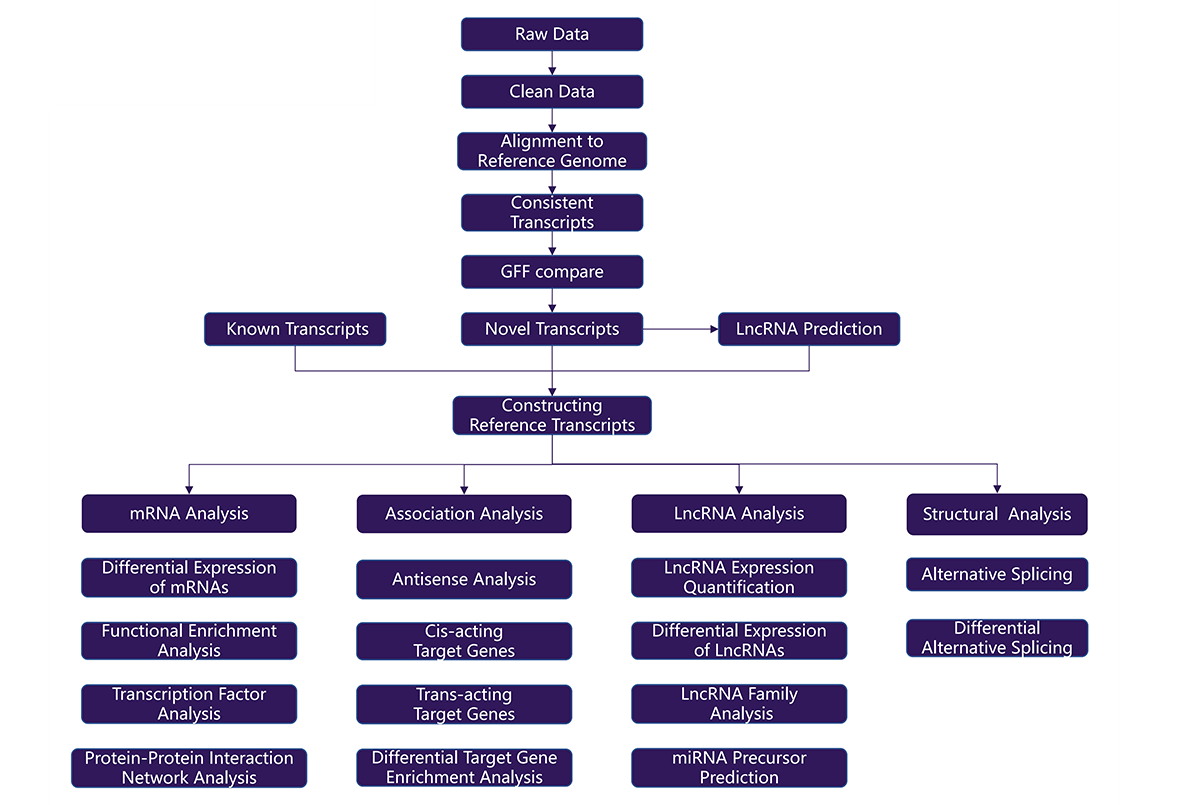
Analysis Workflow
Data Delivery File Formats
FASTQ Data Files
Sample Requirements
|
Sample Types |
Amount | RNA Integrity | Purity |
| Total RNA | ≥3 μg | The RNA sample is clear and transparent, with no insoluble matter. The 28S and 18S main bands are clear, with 28S/18S ratio ≥ 1, and the insect 18S band is clear without any trailing. | A260/280=1.9-2.1; A260/230≥1.0 |
|
Tissue Type |
Full-length lncRNA Sequencing |
|
Dry Weight of Fresh Animal Tissue |
≥300 mg |
|
Dry Weight of Fresh Plant Tissue |
≥500 mg |
|
Freshly Cultured Cells |
≥1-5×10⁶ |
|
Freshly Collected Whole Blood |
4-5 ml |
|
Microbial Biomass |
≥5×10⁶ or ≥0.2 g |
Publications
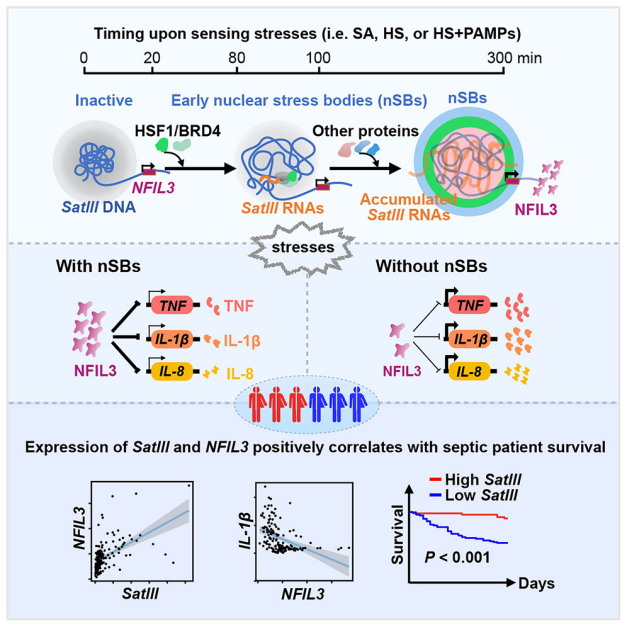
De novo assembly of nuclear stress bodies rearranges and enhances NFIL3 to restrain acute inflammatory responses
Journal: Cell
IF: 45.5
https://doi.org/10.1016/j.cell.2025.05.003
Summary
The membrane-less nuclear stress bodies (nSBs), with satellite III (SatIII) RNAs as the hallmark, are present in primates upon sensing stresses. We report that SatⅢ DNAs, SatⅢ RNAs, and 30 nSB proteins assemble into well-organized structures shortly after stresses. The activated SatⅢ heterochromatin loci rapidly expand, resulting in reduced spatial distance and enhanced expression of adjacent genes, including the transcription suppressor NFIL3, which is known to dampen proinflammatory cytokine production. Rearranging NFIL3 loci within the nSB territory enhances NFIL3 chromatin accessibility and makes NFIL3 promoters more accessible to transcription factors heat shock transcription factor 1 (HSF1) and bromodomain containing 4 (BRD4), which are also recruited to nSBs upon stresses. Human peripheral blood mononuclear cell (PBMC)-derived macrophages under heat shock plus pathogen-associated molecular pattern treatments exhibit increased SatⅢ and NFIL3 expression, the latter of which suppresses key inflammatory cytokines. Importantly, NFIL3 expression positively correlates with SatⅢ activation in septic patients, a process positively correlated to patient survival, highlighting a role of nSBs in restraining inflammatory responses.
What's the best choice?
|
Full-length transcript sequencing |
TAIl Iso-seq |
Direct RNA-seq |
Direct cDNA-seq |
Full-length lncRNA Sequencing |
|
|
Gene quantification |
+++ |
+++ |
+++ |
+++ |
+++ |
|
Gene difference analysis |
+++ |
+++ |
+++ |
+++ |
+++ |
|
Isoform quantification |
+++ |
+++ |
+++ |
+++ |
+++ |
|
Isoform difference analysis |
+++ |
+++ |
+++ |
+++ |
+++ |
|
Alternative splicing |
+++ |
+++ |
+++ |
+++ |
+++ |
|
fusion gene |
+++ |
+++ |
+++ |
+++ |
+++ |
|
novel transcript prediction |
+++ |
+++ |
+++ |
+++ |
+++ |
|
Allele analysis |
+++ |
+++ |
+++ |
+++ |
+++ |
|
Alternative polyadenylation |
+++ |
+++ |
+++ |
+++ |
+++ |
|
Poly(A) length |
NO |
+++ |
+++ |
NO |
NO |
|
LncRNA analysis |
+ |
+ |
+ |
+ |
+++ |
|
Modification analysis(m6A, m5C,Ψ, I) |
NO |
NO |
+++ |
NO |
NO |
|
Positive and negative chain analysis |
+++ |
+++ |
+++ |
+++ |
+++ |
|
Library Construction |
Reverse transcription and PCR amplification |
Reverse transcription and PCR amplification |
Without reverse transcription and PCR amplification |
Only reverse transcription |
Reverse transcription and PCR amplification |
| Sequencing platform |
Nanopore PromethION |
Nanopore PromethION |
Nanopore PromethION |
Nanopore PromethION |
Nanopore PromethION |
Keyword:
Full-length lncRNA Sequencing
Contact Us
If you are interested in our long-read sequencing services or potential collaboration, please contact us. Our team is ready to support your research with tailored solutions. We also welcome feedback from users to help us improve our services.

Contact Us
Add: 82 Wendell Avenue, Pittsfield, Massachusetts, USA
在线客服添加返回顶部
右侧在线客服样式 1,2,3 1
图片alt标题设置: SAILGENE TECHNOLOGY INC.
表单验证提示文本: Content cannot be empty!
循环体没有内容时: Sorry,no matching items were found.
CSS / JS 文件放置地